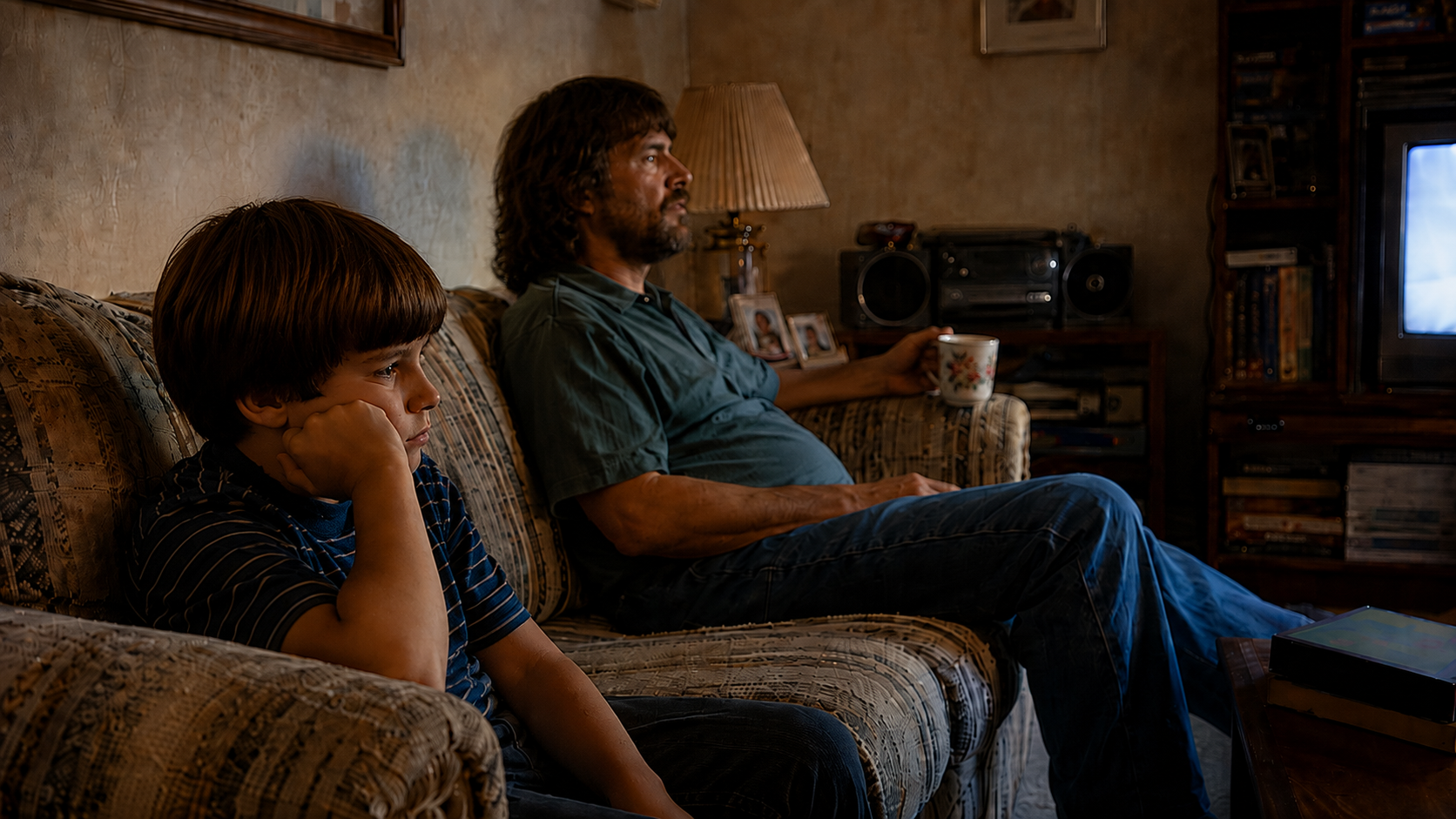
(above: sunday mornings with dad)
+++++
My father was really my big brother.
TV + Radio + Movies + Pop Culture.
When I think back on the weekends I spent with him, that was basically the relationship. We talked about what was on the radio. We watched movies and television. He told me stories from his childhood. We talked about pop culture. He shared things he liked with me. I got “Dad’s Tulsa History Tour” more times than I can count (which sneakily morphed into “Tony’s Childhood with Dad Tour” as the years passed).
But he rarely seemed curious about me.
He never really asked how I was doing at my mother’s house. He didn’t ask how things were going with Sam, my stepfather. He didn’t ask much about school, what I was afraid of, what I was struggling with, or what I needed.
There was no:
How are you, really?
What’s happening at home?
Are you scared?
Is anybody hurting you?
What do you need from me?
Looking back, it feels less like I had a father who was emotionally with me and more like I had a man who knew how to have a kid around him.
And I don’t mean that cruelly.
I think he genuinely loved having me there. I think he enjoyed introducing me to music, movies, television, jokes, stories and all the things he loved. Some of those things became deeply important to me.
But that’s also what an older brother does.
A father has to do something harder.
A father has to turn toward the child and ask what is happening inside him.
That requires emotional maturity because once you ask those questions, you may hear something you have to respond to. You may discover that your child is scared, lonely, confused or being mistreated. Then you have to decide what you’re going to do about it.
My father never seemed equipped for that.
In that sense, “man-child” describes part of my dad pretty well. He could entertain me. He could reminisce with me. He could share his tastes with me. He could hang out with me.
But I’m not sure he knew how to recognize me as a separate little person living a complicated life when I wasn’t with him.
And there is something painful about realizing that when I moved back and forth between those two households, nobody was really checking on the child who lived at my mother’s house.
I carried that whole world with me every other weekend.
Nobody asked me to unpack it.
I wonder now whether my father understands any of this.
He is older. We don’t spend much time together. Sometimes I wonder if there is shame underneath the distance. Maybe age has given him enough perspective to realize, Jesus, I never really knew my kid. I wasn’t there in the ways he needed me.
Or maybe he hasn’t thought about it that way at all.
Maybe he still operates exactly as he always did. Maybe he senses the distance but doesn’t understand it. Maybe he thinks I don’t want a relationship with him. Maybe it’s fear of rejection, emotional immaturity, passivity or some combination of all of it.
From the outside, those things can look almost identical.
What I can see more clearly now is what that relationship taught me.
It taught me that closeness meant shared distractions.
- Music.
- Movies.
- Television.
- Stories.
- Jokes.
- Activities.
Being in the same room.
That is not nothing. There can be genuine love in all of those things.
But intimacy requires another language.
What are you feeling?
What do you need?
What’s happening between us?
Is there something you’re afraid to tell me?
How can I understand you better?
That language was mostly absent from my childhood.
No wonder I had to learn it as an adult.
I spent a lot of my life confusing proximity with intimacy. If we were laughing, listening to music, watching something, going somewhere, having sex, eating together or simply occupying the same space, I could tell myself we were close.
Sometimes we were.
But sometimes we were just together.
There is a difference.
And maybe one of the biggest changes in my life now is that I actually want to know what is happening inside the people I love—and I want them to know what is happening inside me.
I don’t just want somebody around.
I want a relationship where both people are allowed into the room.
