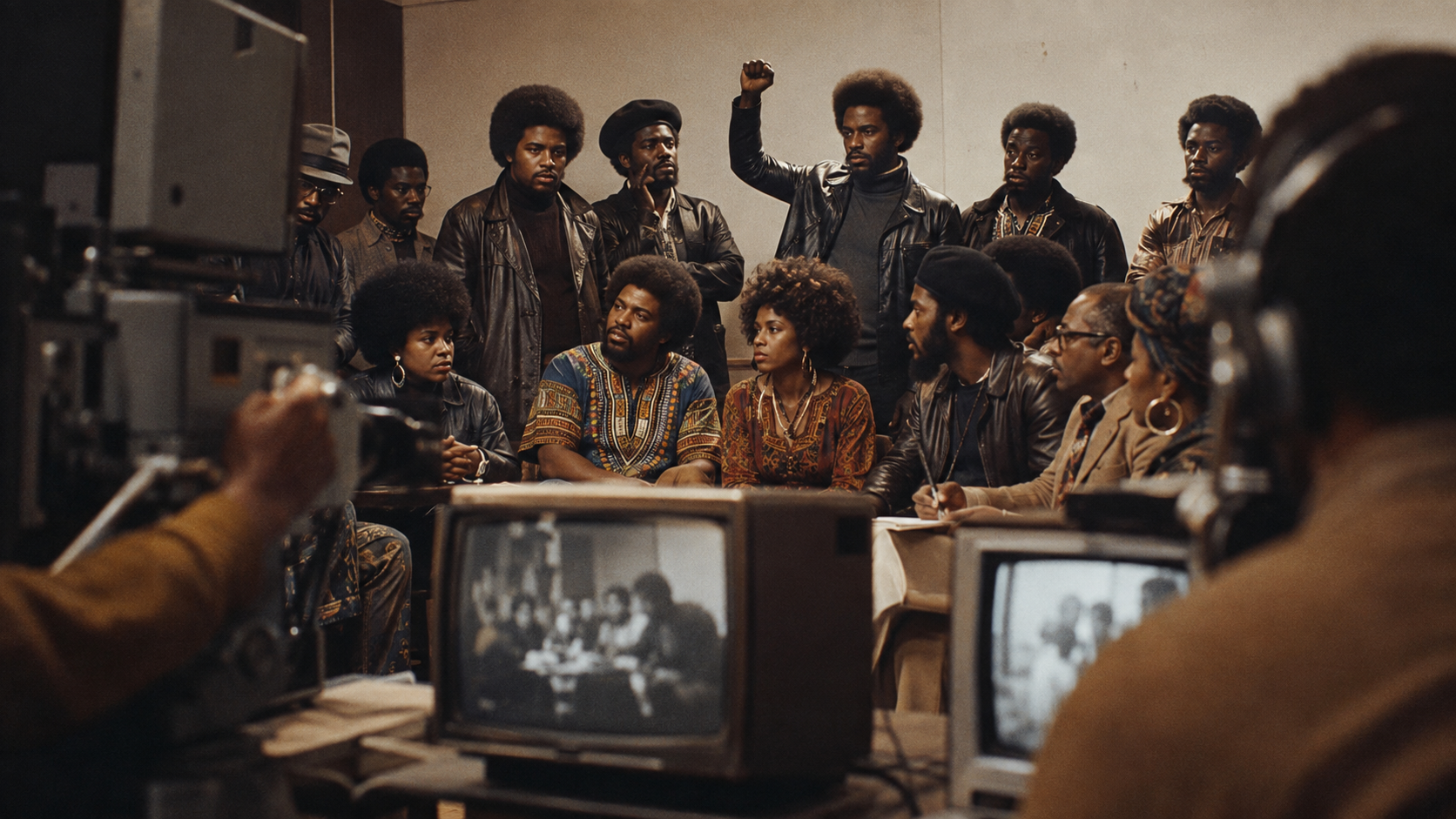
Black people became much more visible in mainstream American media during the 1970s and 1980s, while Black radical political thought became much less visible.
In the late 1960s and very early 1970s, television briefly contained an extraordinary window into Black political consciousness: Malcolm X’s intellectual legacy, Black nationalism, Pan-Africanism, the Panthers, Angela Davis, Stokely Carmichael/Kwame Ture, prison politics, anti-imperialism, community self-determination, African aesthetics, and arguments about capitalism itself. Programs such as Black Journal and Soul! actually let Black intellectuals and activists speak at length rather than merely appear as subjects of white reporting. The Library of Congress describes this period as one in which programs like these brought Black pride and political agency onto television in a way largely unknown to white audiences.
And then much of that space closed remarkably quickly.
Soul! ended in 1973. Black Journal suffered enormous funding cuts; by 1972 only about a quarter of PBS stations were even carrying it, and affiliates sometimes simply refused controversial episodes. It eventually left public television and became Tony Brown’s Journal. The American Archive documents that Black-focused programming lost major public and foundation support during precisely this period.
At the same time, commercial television discovered something much safer and much more profitable: Black representation without Black political power.
So the 1970s give you:
- Sanford and Son
- Good Times
- The Jeffersons
- What’s Happening!!
- Soul Train
- Blaxploitation
- Black musicians increasingly dominating popular culture
Those were culturally significant—sometimes extremely political beneath the surface—but the center of gravity moved from “What does Black liberation require?” toward “Black Americans as participants in American popular culture.”
By the Reagan-era 1980s, that transformation was even stronger. You get Michael Jackson, Prince, Whitney Houston, Eddie Murphy, Oprah, The Cosby Show, etc. Black visibility could become enormous while questions of Black nationalism, imperialism, capitalism, police power, political prisoners, structural racism, community control, and revolutionary organization largely disappeared from ordinary network discourse.
That helps explain the strange sensation when you watch something like The Black Power Mixtape 1967–1975. Swedish television crews recorded lengthy conversations with people such as Angela Davis that American viewers rarely got to experience in that form. PBS’s own description says the movement was being ignored or depicted by American media as violent and potentially terrorist, whereas the Swedish footage preserved far more of its actual intellectual content.
There was also a deliberate narrowing caused by the way mainstream news had framed Black Power in the first place. Media historians have found that network television disproportionately presented Black Power organizations as violent, irrational, or threats to national security. Community programs—free breakfasts, health clinics, political education, liberation schools, food distribution—were much less useful as dramatic television imagery than guns, confrontations and police raids.
And then something even more consequential happened culturally:
Martin Luther King Jr. was rehabilitated into the national story while much of the rest of the Black freedom movement was edited out.
The mainstream memory that developed by the 1980s increasingly became:
Rosa Parks → peaceful marches → “I Have a Dream” → Civil Rights Act → Voting Rights Act → racism defeated.
That narrative leaves remarkably little room for:
Malcolm X → Watts → SNCC → Black Power → King opposing Vietnam and economic exploitation → Fred Hampton → Panthers → Attica → Angela Davis → George Jackson → COINTELPRO → African liberation → American policing and prisons.
Even King himself gets transformed. The King remembered in elementary-school culture is overwhelmingly the 1963 integrationist King, not the 1967–68 King talking about militarism, economic exploitation, Vietnam, urban poverty, and America requiring a “radical revolution of values.”
So somebody growing up on American television in the 1970s–1990s could encounter an enormous amount of Black entertainment while barely being exposed to the political philosophy that had exploded only ten or fifteen years earlier.
That isn’t quite the same thing as saying Black consciousness disappeared. It continued very strongly through Black newspapers and magazines, universities, churches, prisons, music, spoken word, independent media, Pan-African organizations and local political organizing. Ebony and Jet, for instance, continued carrying material mainstream white media often didn’t. But scholarship also finds a broader movement toward commemoration rather than militancy even in some Black historical coverage by the late 1970s and early 1980s.
And this is probably the larger thing you’re noticing:
America didn’t simply forget the Black freedom struggle. It domesticated it.
It retained the parts that could support the national story—individual dignity, integration, interracial harmony, exceptional Black achievement—and gradually marginalized the parts that challenged the underlying distribution of property, policing, wealth, empire and political power.
That makes the 1965–75 period look almost like a missing civilization when you encounter the archival footage now.
And there’s another layer to this that I think would interest you: the same disappearing act happened to the Poor People’s Campaign, the American Indian Movement, Young Lords, Chicano movement, Asian-American radicalism and much of the antiwar left. The public memory of “the Sixties” became hippies, Woodstock, civil rights marches and Vietnam protests, while an extraordinarily sophisticated nationwide argument about colonialism and capitalism inside the United States largely vanished.
That larger erasure is worth unpacking, because it helps explain why the political vocabulary of the late 1960s can sound startlingly contemporary when you actually hear the people speaking for themselves.
