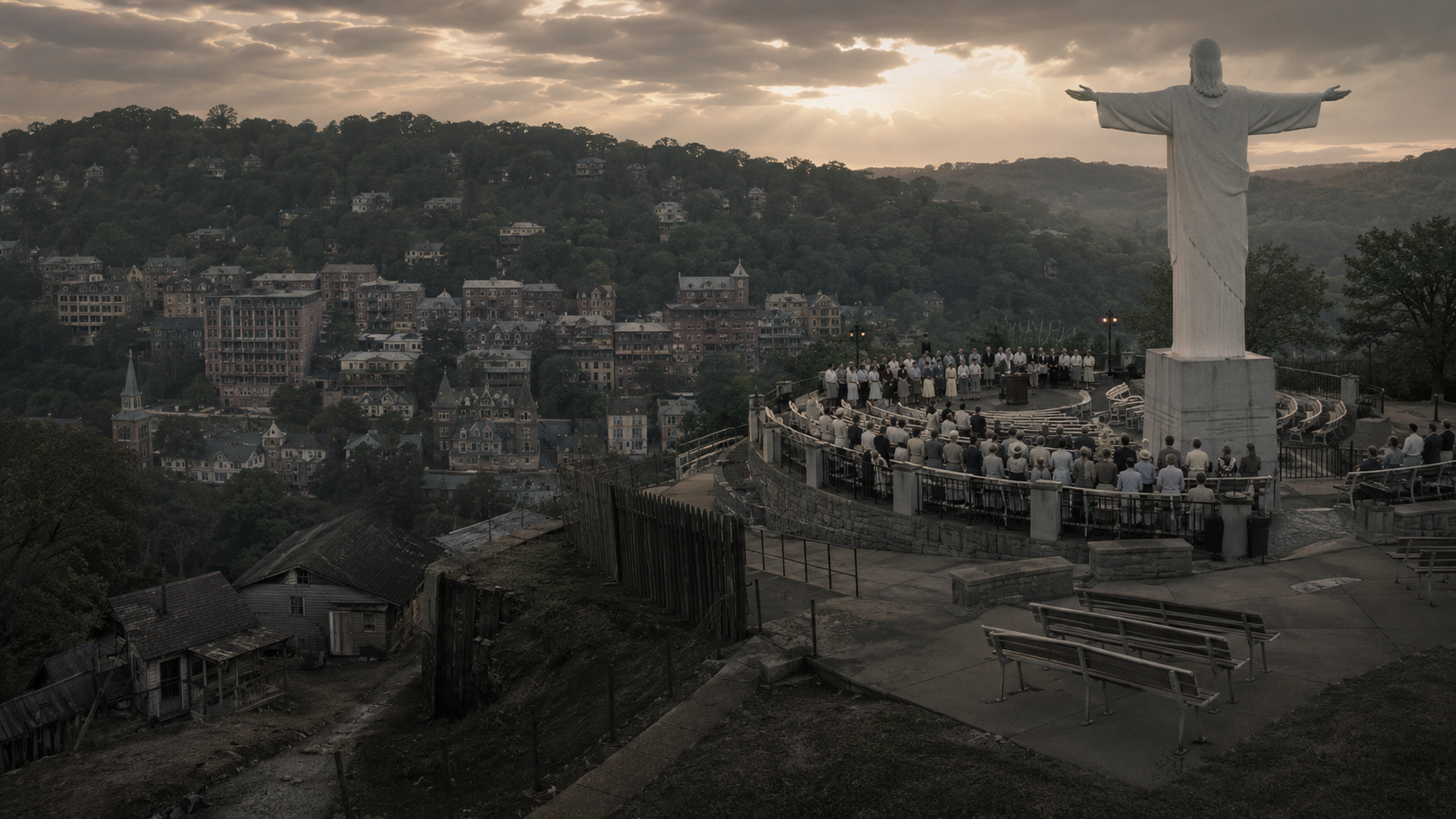
Eureka Springs became quite segregated, especially by the early 20th century, although its racial history is more complicated than “it was always a white-only town.”
During the 1880s resort boom, Eureka Springs actually had a substantial Black community. African Americans owned boarding houses and businesses, worked in hotels and bathhouses, built homes, established a school, and founded an African Methodist Episcopal church. But segregation hardened over time. Black residents were concentrated in a neighborhood around Howell Avenue / the lower slopes near North Main, sometimes called Tin Cup, and were restricted in where they could shop, socialize, stay in hotels, and use the famous mineral springs. Harding Spring was reportedly the only spring open to African Americans. (Shiloh Museum of Ozark History)
By the Jim Crow period, it was severe. One longtime resident recalled that Black residents “weren’t allowed to be down in town” socially and could not use Basin Park like whites could. And in the 1940s, the two known Black children living in Eureka Springs were denied admission to the city schools. By 1970, the census recorded essentially no Black population. (CONTENTdm)
And you do remember a real story about the Black neighborhood being burned, but there’s an important distinction.
Historian Jacqueline Froelich’s research found persistent local oral histories saying that the Ku Klux Klan burned Black residents out of Eureka Springs. One resident explicitly recalled that version of events. However, Froelich also found that the documentary evidence did not conclusively establish a single mass Klan burning that destroyed the entire neighborhood. Buildings disappeared, were demolished or abandoned as the Black population declined, and many former lots remained vacant. So I’d classify it as:
“Longstanding local testimony says the Klan burned Black residents out” — credible oral history, but not yet proven as one documented mass-burning event. (CONTENTdm)
The broader context makes the story less far-fetched, unfortunately. Nearby Harrison experienced explicitly documented racial expulsions in 1905 and 1909, with mobs attacking Black residents and burning homes; some of the people driven from Harrison actually fled to Eureka Springs and Fayetteville. (Encyclopedia of Arkansas)
And Berryville, where your Payne/Weeks family also spent time, is identified by the Shiloh Museum of Ozark History as a sundown town; oral accounts say signs warning Black people not to remain after dark were still present into the 1950s. (Shiloh Museum of Ozark History)
Then there’s an especially ugly later chapter: Gerald L. K. Smith, the antisemitic Christian nationalist and political extremist, moved his headquarters to Eureka Springs in the 1960s. The Encyclopedia of Arkansas specifically notes that he chose Eureka Springs in part because it had become an all-white town. He subsequently created the Christ of the Ozarks/Great Passion Play complex. (Encyclopedia of Arkansas)
